
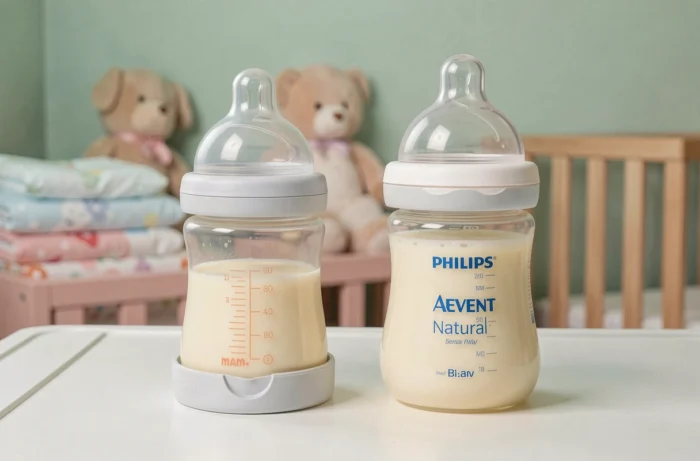
The bottle market in France is largely structured around two brands: Mam, founded in Austria in 1976, and Philips Avent, born in the UK in 1984. Both manufacture products that comply with European standards for food contact materials, but their technical approaches differ in several ways that directly influence baby comfort and parents’ daily logistics.
Anti-colic valve: two designs that address different issues
The most significant difference between Mam and Avent does not lie in the “anti-colic” marketing (both claim this function), but in the location and mechanism of the valve. Understanding this distinction allows you to choose based on your child’s digestive profile.
The Mam Easy Start Anti-Colic bottle uses a ventilated base: air enters through the bottom of the bottle and never passes through the milk. This principle reduces the formation of bubbles and foam in the liquid even before the baby starts feeding. This approach primarily targets infants who swallow air during feeding and suffer from bloating or gas.
Philips Avent, with its Natural Response range, places the valve at the nipple level. The AirFree system, available on some models, complements the setup by allowing the bottle to be given in a more upright position. Air is diverted before reaching the mouth, but the milk maintains a flow conditioned by the child’s active sucking.
By consulting various reviews on Mam or Avent bottles, we see that feedback varies on this point: some babies prone to colic respond better to the ventilation through the base (Mam), while others respond better to the valve integrated into the nipple (Avent). Neither technology has been the subject of a published comparative clinical study that would provide a definitive answer.
Silicone nipple and breast-bottle transition: what the shape really changes
Both brands target parents who are breastfeeding mixed, but with opposing nipple philosophies.
The Philips Avent Natural Response nipple only releases milk when the baby exerts active sucking. The flow stops as soon as the child takes a break, which replicates the natural rhythm of breastfeeding. For an infant alternating between breast and bottle, this function limits the risk of “bottle preference” related to an overly easy flow.
Mam adopts a different strategy with its SkinSoft nipple, which aims to mimic the texture of skin. Its flat and symmetrical shape (known as anatomical) is designed to be accepted by babies accustomed to the nipple. The flow is more consistent, less conditioned by the effort of sucking.
The available data do not allow us to conclude that one nipple shape guarantees a seamless breast-bottle transition without rejection. Each infant’s mouth reacts differently, and most health professionals recommend trying both before investing in a complete set.
Concrete criteria to guide nipple choice
- If your baby is exclusively breastfed and you are introducing the bottle occasionally, the conditioned flow nipple (Avent Natural Response) reduces the risk of breast-bottle confusion
- If your baby shows signs of colic with frequent bloating, the ventilated base Mam should be tested as a priority
- If you are using the bottle from birth with formula milk, both systems are suitable, and the criterion of daily practicality (cleaning, sterilization) may weigh more heavily
Cleaning and sterilization: a clear logistical advantage for Mam
One aspect rarely discussed in comparisons: the design of the Mam Easy Start bottle allows for microwave self-sterilization in three minutes, without additional accessories. The bottle disassembles into three pieces, the base serves as a receptacle for water, and everything goes directly into the microwave.
Philips Avent requires a dedicated sterilizer (sold separately) or cold sterilization. The bottle also disassembles easily, but the operation requires additional equipment. For parents who travel or do not have a sterilizer, this practical difference weighs heavily in daily life.
On the other hand, the wider neck of Avent bottles makes filling and hand cleaning easier, especially for removing residues of thickened formula milk. Mam bottles, with their screw-off bottom, are also easy to clean, but their upper opening diameter is slightly narrower.
BPA Regulation 2026: a criterion that goes beyond brand choice
Both brands have been selling BPA-free plastic bottles for several years. This point is therefore not a differentiating criterion between Mam and Avent today.
What is changing: the European Commission has adopted Regulation (EU) 2024/3190 which provides for a near-general ban on BPA in food contact materials starting July 20, 2026. This regulation goes beyond bottles and concerns all childcare accessories (nipples, rings, lids).
For parents, this means that the “BPA-free” label displayed on the packaging will no longer be sufficient as a guarantee. Manufacturers will need to prove the compliance of all components, including seals and valves. Glass bottles, offered by Avent in its Natural range, provide an alternative that completely bypasses the issue of plastics.
The third player to consider
Comparisons often limit themselves to the Mam versus Avent duel, but Dr Brown’s Options+ Natural Flow bottles are still considered a reference for babies suffering from reflux or confirmed colic. Their internal ventilation system (vent insert) is more complex to clean, but their anti-colic effectiveness benefits from more documented clinical feedback than those of Mam or Avent.

The choice between Mam and Avent is less about overall quality (comparable) than about three concrete trade-offs: the type of anti-colic valve suited to your baby, the intended feeding mode (mixed breastfeeding or exclusive bottle), and the practicality of sterilization in daily life. Buying a bottle from each brand to test your infant’s reaction remains, to this day, the most reliable method.