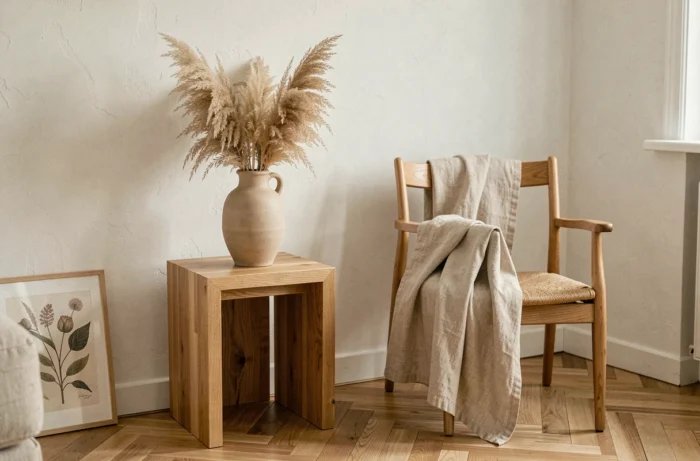
A decorative accessory does not transform a space by its market value, but by its ability to change the perception of a volume, light, or proportion. Enhancing your interior without breaking the bank relies on targeted choices: favor pieces that play a strong visual role rather than accumulating decorative objects without coherence. The budget matters less than understanding what works in each room.
Proportion Effect: Accessories that Change the Perception of a Space
Before choosing an object, one must understand a simple mechanism: a well-sized accessory alters the perception of a room. A mirror placed facing a source of natural light visually doubles the depth of a narrow living room. A tall, slender vase on a low console creates a verticality that enhances a ceiling perceived as too low.
This principle explains why some interiors seem complete with little furniture. The proportion between the object and its immediate environment produces the effect, not the quantity. An oversized cushion on a small armchair overwhelms the seat. The same cushion on a generous sofa structures the backrest.
To identify the right accessories, start by observing the areas of your room that seem empty or unbalanced. A dead corner between two pieces of furniture, a bare wall above a sideboard, a coffee table that feels too bare. It is these specific points that call for an object, not an entire catalog. You will also find decorating tips on Ma Déco Pas Cher that detail selection criteria by room type.
Decorative Textiles: Cushions, Throws, and Curtains at Low Prices
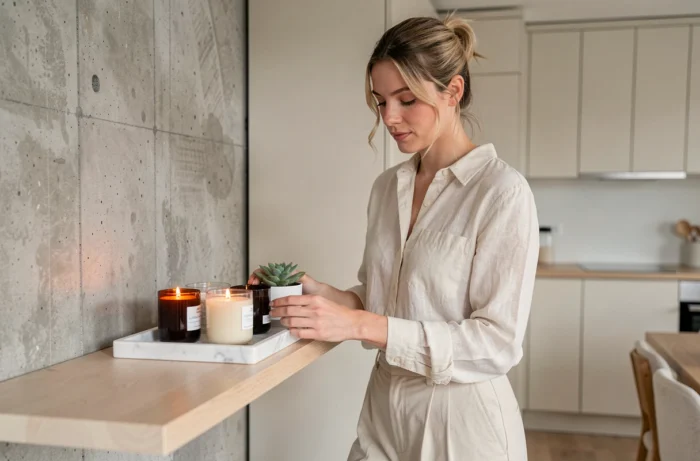
Textiles represent the quickest and least expensive lever to change the atmosphere of a room. Replacing cushion covers transforms a sofa in less than ten minutes. The fabric introduces color, texture, and warmth without heavy intervention.
Three categories of textiles deserve special attention:
- Cushion covers in linen or thick cotton, which age better than synthetic materials and are easy to wash. Varying formats (rectangular and square) on the same sofa breaks the monotony.
- Throws made from natural fibers, placed on an armrest or folded at the foot of a bed. A mixed wool throw adds visible texture even from a distance, enriching the visual reading of the living room or bedroom.
- Curtains in washed linen or slightly textured cotton, which filter light without stifling it. A curtain that falls to the floor visually elongates a wall, even under a standard ceiling.
For interior textiles, regulations are evolving around composition and chemical treatments. Checking the composition information on the label remains a useful reflex, even for low-cost purchases.
Accent Lighting and Light Objects for the Living Room
Main lighting (ceiling lights, spots) is almost never enough to create an ambiance. It is accent lighting that gives personality to a living room or bedroom. A lamp placed on a corner piece of furniture, a string of lights along a shelf, a candle holder on a coffee table: these secondary sources sculpt the volumes in the evening.
The choice of color temperature is as important as the lamp’s design. A warm light (golden hue) is suitable for relaxation spaces. A more neutral light is better suited for an office or entryway. Many affordable accent lamps now come with LED bulbs compatible with a dimmer, allowing you to adjust the intensity according to the time of day.
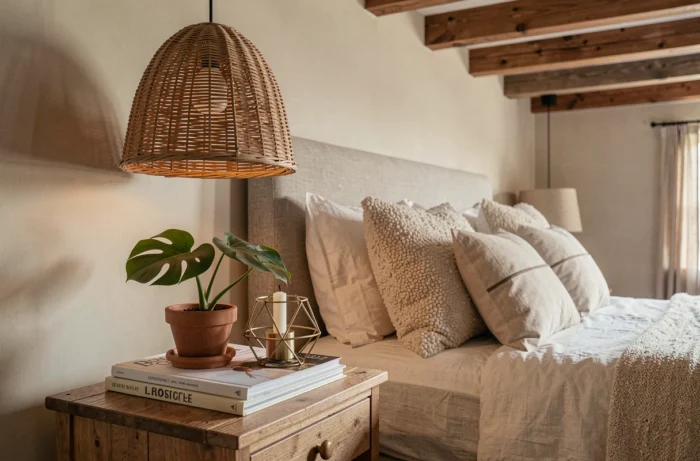
A detail often overlooked: the height of the light source. A lamp placed on the floor shines upwards and enlarges the space. A lamp on a high shelf projects light downwards and creates a cocoon effect. Testing several positions before fixing a location avoids mistakes.
Wall Accessories: Frames, Mirrors, and Open Shelves
Walls represent the largest available surface in any room, yet they often remain underutilized. A dressed wall anchors the style of a room more effectively than a piece of furniture.
Frames do not require a high budget. A series of three identical frames aligned horizontally, containing reproductions or even textured paper, structures a living room or hallway wall. Regular alignment and uniform format produce a graphic effect that random compositions struggle to achieve without experience.
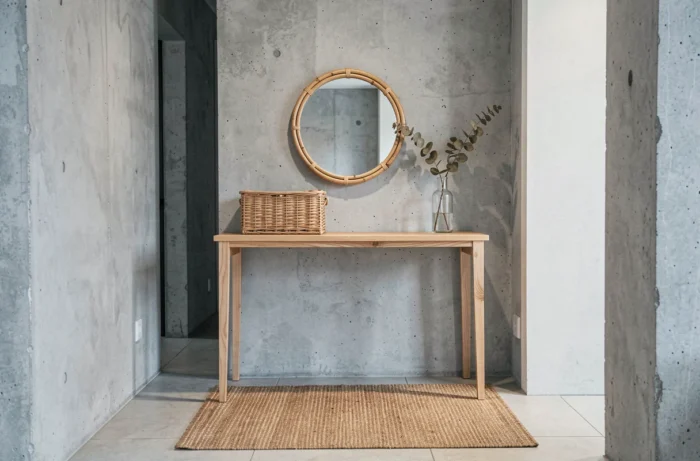
Mirrors, beyond their function, act as fictitious windows. A round mirror above an entryway piece of furniture broadens the visual field right at the threshold. The round format softens a room dominated by straight lines (shelves, doors, baseboards).
Open shelves, fixed in pairs or in a staggered trio, serve both as storage and decorative support. A few books, a candle, a small plant: the content varies with the seasons without needing to repurchase the support.
Second-Hand and Upcycling: Finding Decorative Pieces at Reduced Prices
The second-hand furniture reuse sector has been structured in recent years around eco-organisms that promote repair and reuse. This means that the supply of recovered furniture and accessories is expanding beyond traditional flea markets and peer-to-peer platforms.
The French second-hand market is growing in volume and value, particularly for textiles and household linens. By extension, decorative objects benefit from this dynamic: vases, frames, lighting fixtures, small accent furniture can be found at a fraction of the new price.
Finding an antique object brings a uniqueness that cannot be reproduced in series. A patinated brass candlestick, a handmade ceramic tray, a small beveled mirror: these pieces tell a story that standardized new items cannot offer. Upcycling is not only economical; it creates an interior that looks unlike any other.
Low-budget interior decoration relies less on the number of accessories purchased than on the accuracy of each choice. A well-selected textile, an accent light placed in the right spot, a frame or mirror that corrects a proportion: each piece plays a precise role. The last reflex to keep is to let the space breathe between objects. A half-empty wall is always better than an overloaded one.