Since June 1, 2025, the Brussels Region has banned the installation of new oil boilers. However, the regulatory timeline evolved in 2026, with nuances depending on the type of building and the nature of the work. Comparing deadlines, usage costs, and available alternatives allows for a concrete assessment of what this change means for the affected households.
Excise Duties on Heating Oil: The Hidden Cost of Keeping It in Service
Competing articles focus on the installation ban. They rarely mention the tax lever that is already weighing on households still equipped with an oil boiler.
Excise duties on heating oil increased on August 1, 2026, with a gradual increase trajectory planned until 2029. This increase adds to fluctuations in barrel prices and mechanically raises the annual bill, even without overconsumption.
For a Brussels home heated with oil, the issue is no longer just regulatory. Keeping an existing boiler is still allowed, but the cost of using oil increases each year due to tax brackets. The decision between keeping and replacing is now influenced as much by the energy bill as by the legal deadline.
Before considering a replacement, it is useful to understand the new rules governing this transition, especially when it comes to changing your boiler in Brussels in an existing building.
Regulatory Timeline in Brussels: Deadlines by Building Type
The Brussels timeline is not uniform. Several deadlines coexist depending on the housing situation and the nature of the intervention.

| Situation | Deadline | What is prohibited |
|---|---|---|
| New building | January 1, 2026 | Installation of an oil or coal boiler |
| Major renovation (building permit) | From the permit submission in 2026 | Installation of an oil boiler |
| Existing building (replacement) | January 1, 2031 | Installation or replacement with an oil boiler |
| Replacement of the burner only | December 31, 2034 | Replacement of the burner of an existing oil boiler |
This distinction is often absent from the guides available online. An owner of an existing building still has until 2031 for complete replacement, and until the end of 2034 for a simple burner change. These dates come from an article by the UVCW published on July 30, 2026, and updated on August 20, 2026.
The distinction between complete replacement and burner replacement changes the strategy. A household whose boiler is still functioning properly may consider a burner replacement as a transitional solution while planning to switch to another energy source before 2031.
Heat Pump, Condensing Gas, or Hybrid System: Comparing Alternatives in Brussels
Three solutions consistently appear in projects to replace oil boilers in Brussels. Their technical characteristics and installation constraints differ significantly.
Condensing Gas Boiler
This is the most straightforward option when the home is connected to the gas network. Installation is quick, existing radiators remain compatible, and the investment cost is the lowest of the three options. However, natural gas is also subject to progressive restrictions: Brussels Environment plans a ban on gas boilers in new buildings in the long term.
Air-Water Heat Pump
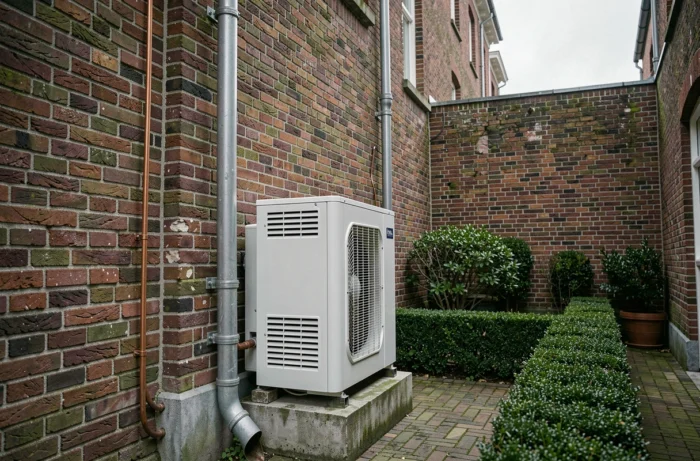
The air-water heat pump extracts heat from the outside air to heat the water in the circuit. It consumes electricity but has a significantly higher efficiency than direct heating. It works best with low-temperature radiators or underfloor heating. In an older home equipped with high-temperature radiators, prior insulation or resizing of the emitters may be necessary.
Hybrid System of Gas and Heat Pump
The hybrid system combines a heat pump and a gas boiler. The heat pump provides heating under normal conditions, while the gas boiler takes over during cold spells. This solution reduces dependence on gas while limiting investment compared to a standalone heat pump. It is particularly suitable for poorly insulated homes where a standalone heat pump would struggle to meet winter heating needs.
The key criteria for choosing between these three systems:
- The insulation condition of the home, which directly affects the efficiency of a heat pump and the necessary supply temperature
- The presence or absence of a connection to the natural gas network, which is still missing in some Brussels municipalities
- The available space for the outdoor unit of a heat pump, a frequent constraint in Brussels row houses
- The available budget for investment, knowing that Renolution grants have been suspended since January 2025
Grants and Financial Aid in Brussels: Current Status in 2026
The suspension of Renolution grants since January 2025 has changed the financial calculations of many projects. This suspension affects new applications and directly impacts the return on investment of a heat pump or hybrid system.
Without regional grants, the cost gap between a gas boiler and a heat pump widens at the investment stage. The differential is offset on the energy bill over the years, but the payback period lengthens. Households considering a heat pump should keep an eye on the potential resumption of the grant program, the terms of which remain uncertain at the time of writing.
The increase in excise duties on oil until 2029, combined with the 2031 deadline for existing buildings, creates a clear decision window. Waiting until 2030 to replace exposes the risk of installer saturation as the deadline approaches, with potentially higher labor costs and delays. The regulatory data all point in the same direction: the earlier the replacement is anticipated, the more controlled the technological choice and work schedule remain.