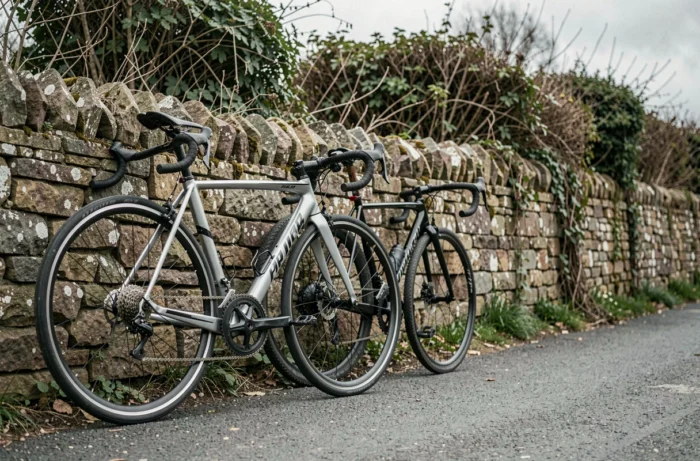
The Triban RC 120 and the GRVL 120 share an almost identical technical base: aluminum frame, Shimano 2×8 speed transmission, mechanical disc brakes. On paper, the difference between the two is slim. We recommend focusing the analysis on three specific points: geometry, tire clearance, and usage consistency, rather than the marketing category of “road” versus “gravel.”
Geometry of the RC 120 and GRVL 120 Frame: The Gap That Changes Position
The RC 120 adopts a road-oriented geometry with a tighter head angle. The trail is short, the handling is responsive at high speeds, and the torso position remains relatively engaged for an entry-level bike.
The GRVL 120 lengthens the wheelbase and opens the head angle. The direct consequence is an increased stability at low speeds on loose terrain. The slightly shorter reach raises the torso by a few degrees, relieving the lower back on long rides.
For a cyclist who primarily rides on pavement, this “gravel” geometry results in a bike that is a bit less responsive during accelerations and less precise in tight cornering sequences. If your routes involve few paths, the geometry of the RC 120 remains more consistent for daily use.
We regularly observe that buyers overestimate their time spent off-road. If you analyze your differences between the Triban RC 120 and the GRVL 120 from the perspective of actual usage, the RC 120 is better suited as soon as pavement exceeds 80% of the mileage.

Tire Clearance: 32 mm vs. 38 mm, a Structural Choice
The RC 120 accepts tires up to about 32 mm in width. The GRVL 120 accommodates 38 mm, which is the most significant functional difference between the two bikes.
Six millimeters of additional width change several parameters at once:
- The air volume increases, which lowers the possible inflation pressure and improves comfort on rough roads or cobblestones
- The contact surface with the ground widens, providing more grip on dirt, fine gravel, or wet grass
- The rolling weight slightly increases, and the rolling resistance on clean asphalt is a bit higher at equal pressure
By fitting a 32 mm slick tire on the RC 120, you get an efficient road bike with minimal comfort over pavement imperfections. The GRVL 120 equipped with 38 mm tires and a semi-knobby profile becomes a bike capable of handling unpaved paths, but slightly less agile on flat tarmac.
Tubeless Compatibility and Wheels
Both models come with tube-type wheels. Tubeless compatibility depends on the rims and often requires an upgrade. In this price range, neither the RC 120 nor the GRVL 120 offers tubeless-ready rims as standard. Switching to tubeless involves changing wheels, an investment that exceeds the price difference between the two bikes.
Mixed Use for Road and Commuting: Which Triban to Choose Based on Your Route
The debate of RC 120 versus GRVL 120 consistently arises in discussions about commuting. Both bikes can accommodate fenders, a light cargo rack, and lights. The real question concerns the nature of the home-to-work route.
A 100% urban route on bike paths and roads favors the RC 120. Its lower geometry optimizes pedaling efficiency, and tires ranging from 28 to 32 mm are more than sufficient to absorb common potholes.
A route that passes through a park, runs alongside a canal on a stabilized path, or regularly includes unpaved sections justifies the extra cost of the GRVL 120. The larger tire section and more stable geometry make these passages comfortable without significantly slowing down the rest of the ride.

The Trap of “Just in Case”
Choosing the GRVL 120 “just in case” you might do gravel one day is a common but debatable reasoning. A bike optimized for your primary use will always be more enjoyable than a compromise aimed at a hypothetical use. If gravel truly attracts you, a dedicated bike with a clearance of 40 mm or more and a carbon fork will be much more relevant in the medium term.
Transmission and Braking: Identical Specs That Don’t Differentiate
Both bikes use a Shimano Claris 2×8 speed group with similar gear ratios. The compact crankset offers a sufficient range for moderate climbs and rolling sections. The mechanical disc brakes operate identically on both models.
Neither bike has an advantage in terms of transmission or braking. It’s a point to keep in mind: the price difference between the RC 120 and the GRVL 120 does not finance a qualitative leap in components. It pays for the geometry, clearance, and tires supplied as standard.
For cyclists considering a future upgrade, the frame of the GRVL 120 offers slightly more room for tire evolution. The frame of the RC 120 limits changes to a maximum section of 32 mm, which restricts options if your preferences change.
The choice boils down to a question of proportion. 90% road and a few occasional paths clearly point towards the RC 120. A truly mixed use, with unpaved sections every week, makes the GRVL 120 more logical. In both cases, the mechanical base is the same, and the pleasure of riding will largely depend on your tire pressure and the quality of your saddle.