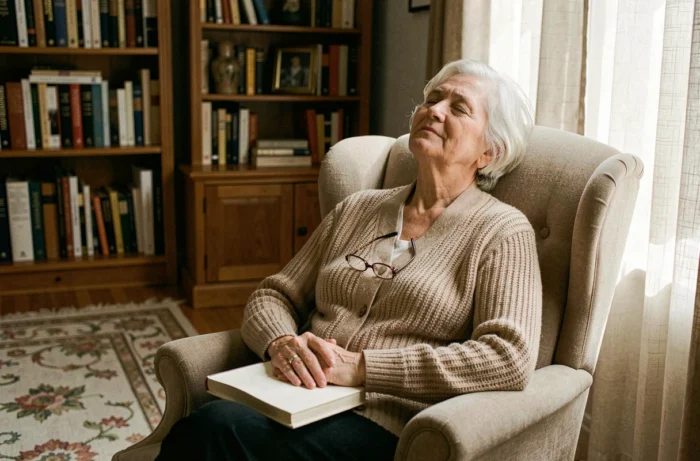
In many elderly individuals, the eyelids close without sleep being the cause. This behavior, often interpreted as a sign of drowsiness or cognitive decline, actually stems from precise physiological mechanisms. The aging brain reallocates its sensory resources, and the closing of the eyes contributes to this reorganization much more than one might assume.
Postural Control and Eye Closure in Seniors
Maintaining balance relies on three systems: vision, the vestibular system (inner ear), and proprioception (sensors in muscles and joints). In a young person, these three channels work in fluid complementarity. With age, vision often takes on a dominant role to compensate for the decline of the other two.
Research published in journals like Frontiers in Aging Neuroscience and PLOS One shows that when seniors close their eyes, the brain is forced to rely more on the vestibular system and proprioception. This sensory redistribution, measured by analyzing the oscillation speed of the center of pressure, reveals a reduction in the flexibility of postural control with age.
Therefore, closing the eyes is not a surrender. The brain shifts to a different processing mode, and this shift can occur reflexively in seniors whose visual system generates contradictory or overly costly information to process. Understanding why some elderly people keep their eyes closed requires going beyond simple fatigue to consider this logic of sensory compensation.

Visual Fatigue and Age-Related Sensory Overload
The lens hardens with age, the pupil reacts more slowly to changes in light, and tear production decreases. These changes, documented by the MSD manual, create chronic eye fatigue that seniors do not always verbalize.
In a bright or visually busy environment (TV on, very bright room, passage of several people), closing the eyelids acts as a protective filter. The brain reduces the amount of information to process to conserve its attentional resources.
This sensory overload is amplified by certain common medications in geriatrics. Treatments that affect the central nervous system (anxiolytics, antidepressants, opioid analgesics) can slow visual processing and make prolonged eye opening uncomfortable. Closure then becomes a spontaneous adjustment, not a symptom of loss of consciousness.
Chronic Pain and Voluntary Sensory Withdrawal
Pain profoundly alters visual behavior. Closing the eyes in response to pain is not a metaphor. It is a neurological mechanism by which the brain cuts off a sensory channel to free up processing resources dedicated to managing the pain signal. In seniors suffering from osteoarthritis, neuropathies, or post-operative pain, this strategy can become nearly permanent during phases of acute pain.
Family members often interpret this withdrawal as apathy or a sign of depression. The distinction lies in observing the context:
- Does the person react when spoken to, even with their eyes closed? If so, consciousness is preserved, and the withdrawal is likely sensory.
- Does eye closure coincide with moments of physical mobilization (transfers, bathing, walking)? This suggests pain management.
- Does the behavior intensify after taking certain medications? The sedative effect should then be evaluated by the treating physician.

Closed-Eye Exercises in Balance Rehabilitation
What surprises families is sometimes encouraged by healthcare professionals. Recent protocols in geriatric physiotherapy explicitly incorporate eye closure sequences into balance exercises, for short periods of ten to fifteen seconds in a stable position.
The goal is to reduce excessive reliance on vision and train the vestibular and proprioceptive systems, whose decline increases the risk of falling. The modified Romberg test, used in clinical assessment, is based on this same principle: comparing postural stability with eyes open and then closed to quantify the visual contribution to balance.
This therapeutic approach nuances the perception of a senior who regularly closes their eyes. A behavior perceived as passive may reflect active training of the brain to function without visual information, especially if the person is following a rehabilitation program.
When Eye Closure Signals a Health Problem
Not all cases fall under physiological adaptation. Certain signals should prompt a rapid medical consultation:
- Eye closure accompanied by a complete lack of reaction to verbal and tactile stimuli may indicate a neurological disorder or altered consciousness.
- A sudden change in behavior (the person kept their eyes open and suddenly starts closing them permanently) warrants a medical evaluation, particularly to rule out a stroke or a medication side effect.
- Eyelids that remain closed due to blepharospasm (involuntary contraction of the orbicularis muscle) require specific ophthalmological or neurological diagnosis.
The line between normal adaptation and warning signal lies in the gradual or abrupt nature of the change and the quality of the response to external stimuli.
The reflex to close the eyes in a senior rarely indicates disengagement from the world. Whether it is sensory redistribution, pain management, or postural training, the aging brain continues to optimize its resources, including choosing to temporarily cut off visual input.