
The high-tech landscape of 2026 is structured around a regulatory and technical shift: artificial intelligence is moving out of the experimental phase to become an embedded component in most consumer products. The transparency rules of the European AI Act now apply to AI systems that interact directly with users, from chatbots to voice assistants integrated into connected devices. This framework alters the very design of tech products sold in the European market.
AI Act and mandatory transparency: what changes for tech products in 2026
The European AI Act imposes new obligations on manufacturers and publishers of products integrating artificial intelligence. Transparency requirements are tightening, with a phased implementation schedule now affecting consumer systems.
Any high-tech service used in the European market must now clearly inform the user that they are interacting with an AI. Content generated or altered by artificial intelligence (images, audio, video, text) must be marked in a machine-detectable way, through watermarking or embedded metadata.
The penalties provided are significant and can represent a percentage of global revenue. These obligations do not only concern industry giants: start-ups, content creator platforms, agencies, and media are also targeted.
For consumers, the direct consequence is visible as soon as they purchase a connected device or download an app: transparency notices appear in interfaces, and products that do not comply risk being withdrawn from the European market. You can discover the tech section of Mimi La Cocotte, which regularly covers the impact of these regulations on everyday products.

Embedded AI and edge computing: local processing replaces the cloud
The most structuring trend on the hardware side concerns local data processing, directly on the device, without passing through a remote server. Manufacturers of smartphones, smart glasses, and home sensors are integrating chips dedicated to AI inference.
This shift of computation to the edge of the network (edge computing) addresses two simultaneous constraints:
- Latency: a voice assistant or vision-based navigation system must respond in real-time, which the round trip to the cloud does not always allow.
- Privacy: with the tightening of European regulations, processing data on the device reduces exposure to transfer and storage obligations.
- Availability: a connected device that operates without a permanent connection remains functional in areas with weak network coverage.
Multi-agent systems, where several AI modules collaborate locally to accomplish a task, are beginning to appear in consumer products. A thermostat can coordinate its decisions with presence sensors and a solar panel without going through a centralized server.
Smart glasses and spatial interfaces: beyond the touchscreen
Interaction with tech objects is evolving. Smart glasses, long confined to professional uses or trade show demonstrations, have reached a sufficient level of maturity for the general public. Gesture recognition, eye tracking, and haptic feedback are gradually replacing the touchscreen as the primary mode of interaction in certain contexts.
Spatial interfaces transform the physical space into an interaction surface. A technician visualizes a repair manual overlaid on the machine they need to maintain. A chef consults a recipe projected onto their countertop without touching a screen.
This convergence between augmented reality and local artificial intelligence raises a question of software design. Applications must be rethought to operate in a three-dimensional environment, with contextual data provided by the device’s sensors.
Predictive security and self-repairing software: the invisible layer
Cybersecurity is changing paradigms. Traditional security systems, based on the detection of known signatures, are giving way to behavioral analysis models powered by AI. The software monitors normal usage patterns and triggers an alert as soon as a significant deviation appears.
On the software side, so-called “self-repairing” architectures are progressing. The principle: a program detects its own malfunctions and applies a fix without human intervention. Security updates are deployed in the background, sometimes even before the vulnerability is exploited.
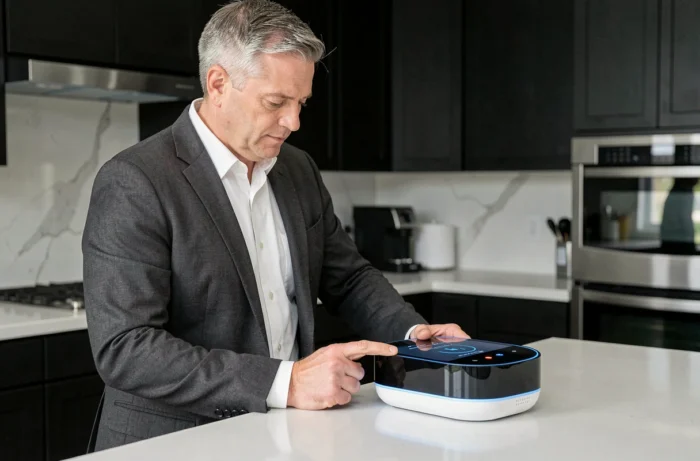
For the user, this layer remains largely invisible. It manifests as a reduction in service interruptions and less frequent but more precise security notifications. Connected home objects (locks, cameras, thermostats) directly benefit from these advancements, provided the manufacturer maintains an active update cycle.
Points of vigilance for buyers
A connected device whose manufacturer does not specify the duration of software support poses a medium-term security risk. Products compliant with the AI Act now display information about their software lifecycle, making it easier to choose.
Connected objects and smart home: the mesh tightens
The connected home is no longer just a voice speaker and a few smartphone-controllable light bulbs. The mesh between sensors, actuators, and local decision systems creates an environment where objects communicate with each other without going through a central application.
Communication protocols like Matter, designed to unify smart home ecosystems, facilitate interoperability between brands. An air quality sensor from one manufacturer can trigger the ventilation of another, without complex configuration.
The arrival of specialized language models, trained on restricted datasets and optimized to run on low-power devices, allows smart home assistants to understand more nuanced queries. The difference with previous generations lies less in raw power than in the contextual relevance of the responses.
The European regulatory framework pushes manufacturers to rethink data collection in the connected home. Each sensor must justify the data it collects and the duration of retention. This constraint, perceived as a hindrance by some industry players, becomes a selling point for consumers concerned about their privacy.