A slime that drips between the fingers indicates an imbalance in the activating/polymer ratio. Before adding anything, it is essential to identify the base recipe used, as the correction depends directly on the type of polymer involved. Here, we detail the recovery mechanisms by formulation family, including the dosages and techniques that make the difference between a salvaged slime and a permanently ruined one.
Activating/polymer ratio: the diagnosis before any slime correction
The excessive fluidity of a slime always indicates a deficiency of the crosslinking agent compared to the amount of polymer (PVA glue, clear glue) or an excess of aqueous phase. Randomly adding a thickener often exacerbates the problem.
We recommend starting with a simple test: stretch a small portion of the slime between two fingers. If the strand breaks cleanly in less than a second, the activator is insufficient. If the slime stretches softly and then drips, the liquid phase is dominant. The stretching behavior determines the correction to be applied.
To know what to do if my slime is too liquid, this distinction is fundamental: adding activator to a slime already saturated with boron (or boric acid) will turn it into an irrecoverable rubbery block.
Recovering a PVA glue and saline solution slime
Recipes based on white PVA glue combined with a saline solution (physiological serum + baking soda) are the most common. When this type of slime becomes too liquid, the main cause is an insufficient dosage of baking soda.
Add baking soda by half a teaspoon, kneading for at least two minutes between each addition. Baking soda acts as a co-activator in the presence of boric acid contained in the physiological serum. A common mistake is to pour more serum without baking soda, which dilutes the mixture instead of crosslinking it.
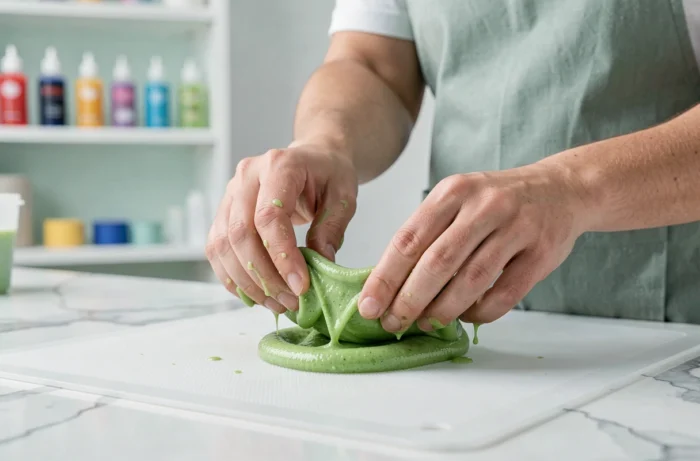
If the slime remains sticky after three successive additions, move on to the next method: incorporate a dollop of shaving foam (foam, not gel) and knead vigorously. The foam introduces air into the matrix and absorbs excess moisture without altering the crosslinking. The result will be a fluffy slime that is slightly larger but with a manipulable consistency.
The cornstarch option for borax-free slimes
Recipes without boron activator (slime based on shower gel, toothpaste, or shampoo) rely on physical rather than chemical bonds. Cornstarch (Maïzena) is the reference corrector here.
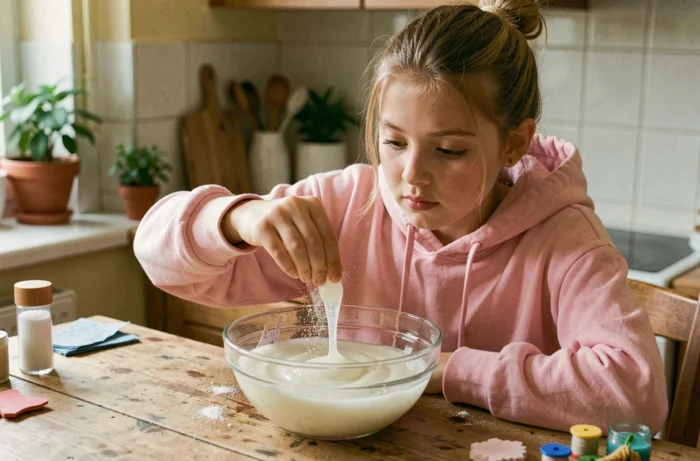
- Sprinkle a tablespoon of cornstarch over the flat spread slime, then fold and knead. Repeat until the desired consistency is achieved.
- Do not exceed three tablespoons in total, or you risk obtaining a crumbly paste that loses all elasticity.
- If the slime contains shower gel, add the cornstarch alternately with a few drops of clear liquid glue to maintain the stretchiness.
Cornstarch absorbs free water but does not create crosslinking. The slime corrected this way will have a shorter lifespan and should be stored in an airtight container.
Borax slime: safety precautions and limits of recovery
Borax (sodium tetraborate) remains the most potent activator for crosslinking PVA glue. In Europe, it is classified as CMR, and its use in toys is strictly regulated. Recent alerts still report commercial slimes with excessively high boron migration, reminding us that handling this ingredient at home poses a real health issue.
For formulations that use a diluted borax solution, recovering a too liquid slime involves a very gradual addition:
- Prepare a solution with a very low concentration (a pinch of borax in a glass of warm water) and add it drop by drop, never directly in powder form onto the slime.
- Knead thoroughly between each addition: the crosslinking of PVA by boron takes several minutes to stabilize.
- Wear thin gloves and avoid any contact with mucous membranes. If in doubt about the amount already present, it is better to start a new base than to overdose on boron.
The introduction of a digital product passport for toys sold in the EU will facilitate the verification of the composition of slimes purchased in stores. For homemade slime, this traceability does not exist: the responsibility for dosage rests entirely with the amateur manufacturer.
Storage and prevention: preventing slime from becoming liquid again
A properly formulated slime can become liquid again within a few days if storage conditions are not suitable. Ambient humidity and heat accelerate the degradation of the bonds between the polymer and the activator.
Store the slime in an airtight container, at a stable room temperature, away from direct heat sources. Some add a few drops of saline solution before closing the container to maintain active crosslinking.
We observe that slimes based on clear glue degrade faster than those based on white PVA glue. Clear glue contains more aqueous solvent, which weakens the structure over time. If you prepare a slime intended to last several weeks, prefer white glue and a bicarbonate-based activator plus physiological serum.
Regular kneading (one to two minutes per day) also helps redistribute moisture within the mass and delays phase separation. A slime that starts to sweat a clear liquid on the surface is not lost: drain the liquid, add half a teaspoon of baking soda, and knead. The texture will return in most cases.