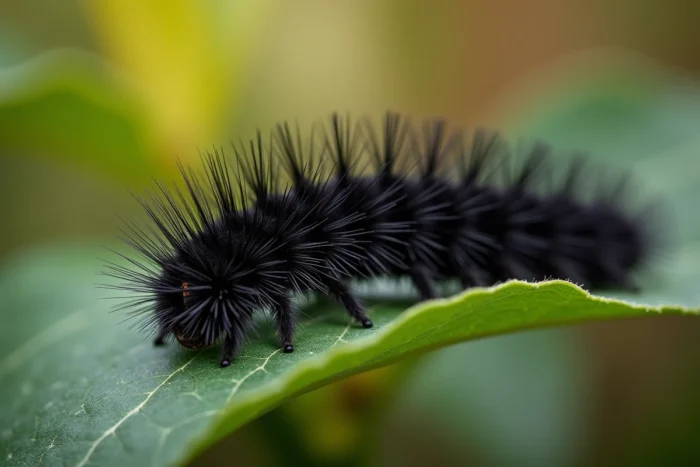
A black and hairy caterpillar crosses your terrace or munches on a leaf in the vegetable garden. The first instinct is often to back away, fearing a processionary caterpillar. The good news: the vast majority of black and hairy caterpillars visible in a French garden are harmless. However, it is essential to know how to distinguish them, as color and hairiness alone are not enough to decide.
Host plant and type of hairs: the duo that guides identification
Before searching for the species name, look at where the caterpillar is located. This simple and reliable criterion is often more useful than a blurry photo posted on a forum.
A black and hairy caterpillar found on nettles is very likely the larva of a common butterfly like the Peacock butterfly. It has branched spines, not fine hairs, and poses no risk to touch. In contrast, dark caterpillars grouped in a line or cluster on an oak or pine point towards processionaries, whose microscopic hairs are stinging.
The principle is straightforward: the host plant filters the risk even before closely observing the caterpillar. On fruit trees, ivy, or grasses, the black and hairy species encountered are almost always safe. To identify a black and hairy caterpillar more accurately, the combination of host plant and hair morphology remains the most reliable method.
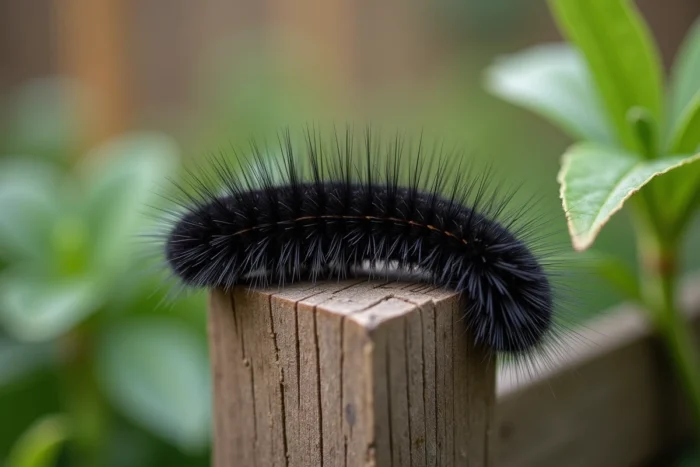
Next, look at the texture of the hairiness. Long and flexible tufts, often brown or reddish, indicate species of silk moth (like the Bramble Moth). Short, very dense hairs arranged in mirrors on the back suggest processionaries. This tactile distinction, visible to the naked eye from a few centimeters away, changes everything.
Hairy black caterpillar or sawfly larva: a common confusion
Have you ever spotted a small black “caterpillar” on a rose bush or a currant bush that doesn’t quite match the pictures in guides? There’s a good chance it’s a sawfly larva, an insect from the order Hymenoptera (the one that includes wasps and bees), and not a lepidopteran.
Sawfly larvae are not caterpillars, even though they resemble them closely. The most reliable difference: count the pairs of false abdominal legs. True butterfly caterpillars have a maximum of five pairs. Sawfly larvae have six or more.
This distinction is not just anecdotal. It has a concrete impact on garden management:
- Butterfly caterpillars are sensitive to Bacillus thuringiensis (Bt), a common biological treatment. Sawfly larvae do not react to it at all.
- Sawflies do not spin silk webs. If you see silky threads around the leaves, it is indeed a lepidopteran caterpillar.
- Sawfly larvae drop to the ground when disturbed, curling up in a spiral. Hairy caterpillars usually remain clinging to their support.
Overlooking this confusion risks applying an unnecessary treatment or getting alarmed over a completely harmless insect.
Common black and hairy species in French gardens
Rather than an exhaustive catalog, let’s focus on three species you are most likely to encounter, and what makes them recognizable without a magnifying glass.
The Garden Tiger Moth (Arctia caja)
Its caterpillar is spectacular: a black body covered with long brownish-red hairs, with darker tufts. It can be found on various low plants (plantain, dandelion, nettle). Despite its impressive appearance, it does not cause any skin reaction. It often moves along the ground towards the end of its development, which explains why it is seen on paths or terraces.
The Bramble Moth (Macrothylacia rubi)
A large, very hairy caterpillar, brown-black with reddish reflections, visible in autumn on brambles, heathers, and other low plants. It overwinters on the ground, curled up. Its body covered with dense and flexible hairs clearly distinguishes it from processionaries, whose hairiness is short and segmented into regular bands.
The Gypsy Moth (Lymantria dispar)
The caterpillar is recognizable by its colorful dorsal warts (blue and red) on a dark and hairy body. It feeds on oaks and many broadleaf trees. This species can pose a forestry problem in case of an outbreak, but in the garden, a few individuals do not warrant any intervention.
Processionary caterpillars: the real warning signals
Since the main concern remains the processionary caterpillar, here are the criteria that truly distinguish it from other black and hairy species.
- Pine processionaries move in a single file, nose to tail. This gregarious behavior in a straight line is their most visible signature, even from a distance.
- They build whitish silk nests in pines or cedars (pine processionary) or form clusters on oak branches (oak processionary).
- Their stinging hairs are microscopic and detach into the air. The reaction does not come from direct contact with the caterpillar, but from these invisible micro-hairs that disperse around the nest.
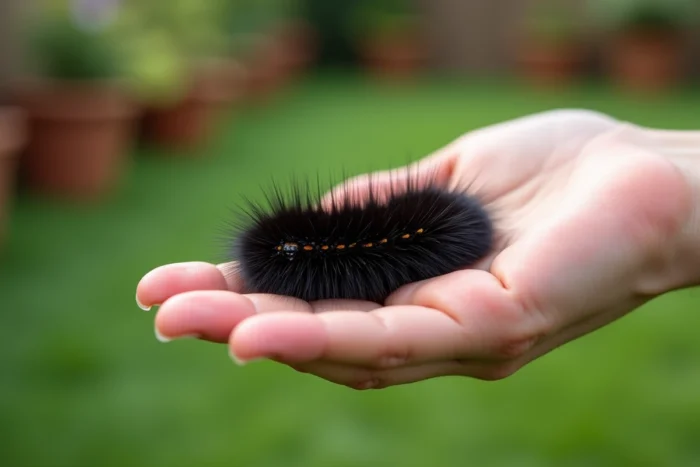
Grouping in procession and the presence of white silk nests in a conifer are the two most reliable indicators. An isolated black and hairy caterpillar on a low plant does not match the profile of a processionary.
If in doubt about a nest spotted in a pine or oak, the appropriate reflex is not to touch it, to keep children and pets at a distance, and to contact the town hall or a pest control professional who also deals with processionaries. Handling a nest without protection exposes you to stinging hairs even if the caterpillars seem inactive.
The next time a black and hairy caterpillar appears in your garden, a look at the plant it is on and the shape of its hairs will give you a much more reliable answer than its color alone. In the vast majority of cases, you are simply observing a future moth finishing its growth.