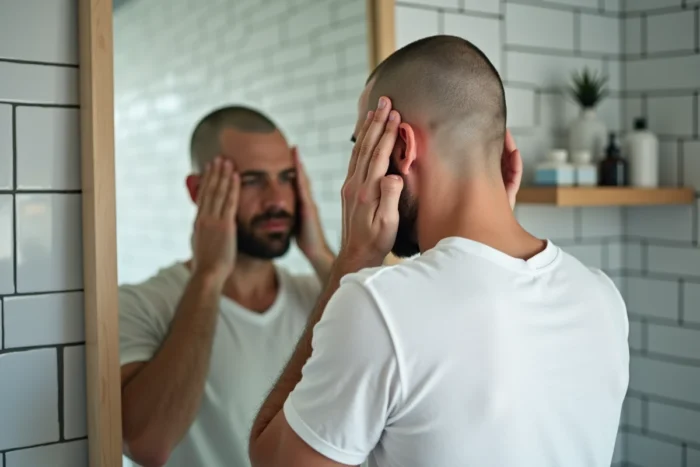
Before wielding the clippers, the question deserves to be asked differently: the outcome of a shaved head depends on several combined factors. The morphology of the face, the texture of the skin, the presence or absence of a beard, and even the clothing style radically alter the final result. Shaving the head remains a difficult decision to simulate, and feedback varies on this point depending on each person’s profile.
Skull and face morphology: what really changes the result
Most online guides simply classify face shapes (oval, round, square) to predict whether a shaved head will suit someone. This framework remains limited. Two oval faces can yield very different results depending on the height of the forehead, the prominence of the brow ridges, or the symmetry of the skull when viewed from above.
A rarely addressed point: the bumps and asymmetries of the skull only reveal themselves once the hair is removed. The scalp conceals contours that no one suspects before the first shave. Flat areas on the sides, a very pronounced occiput, or slight frontal asymmetry become visible and contribute to the overall impression.
To evaluate the outcome without going straight to the act, several methods exist. Hair simulation applications allow testing different angles of view before taking the plunge. Reliability varies depending on the tool, but the exercise helps identify potential disproportions. Knowing how to shave your head properly also involves understanding what the razor will reveal.

Another approach is to gradually shorten the length with clippers, going through intermediate stages. A trim to three millimeters already gives a faithful preview of the skull shape without the full commitment of a clean shave.
Beard, glasses, and clothing: a shaved head is judged as part of a whole
A shaved head does not stand alone. Recent guides emphasize that a shaved head can appear harsh or cold if not accompanied by suitable clothing choices and accessories. Many people change their minds about their haircut once these adjustments are made.
The beard plays a central role. A structured beard rebalances a face that a shaved head can elongate or round out, depending on the case. Without a beard, the focus shifts to the facial features and the skin of the scalp, which requires particular care for the scalp and healthy skin.
Glasses are an underestimated lever. Contemporary frames, slightly thick, add a focal point to the middle of the face and break the “uniform” effect that some attribute to a bare skull. Conversely, thin and discreet frames can accentuate an impression of severity.
On the clothing side, warmer textures and colors compensate for what shaving the head removes in visual softness. Materials like linen, knit, or corduroy create a contrast with the nakedness of the skull.
- A beard of a few days to a few centimeters restructures the proportions of the face and softens the overall look
- Thick or colorful glasses frames provide a visual anchor that balances the bare skull
- Warm clothing textures (knit, linen, wool) soften the raw effect of shaving and give a more approachable look
Baldness and chosen shaving: two approaches, one visual result
The motivation behind shaving alters how one experiences the result. Emerging baldness, with marked receding areas or thinning at the crown, often pushes one to take the plunge to regain a clean line. In this case, a shaved head simplifies maintenance and eliminates the daily management of thinning areas.
The purely aesthetic shave, without hair loss, follows a different logic. The psychological reversal is simpler since the hair will grow back evenly. This distinction matters because it influences tolerance during the first weeks of adjustment, often the most destabilizing.
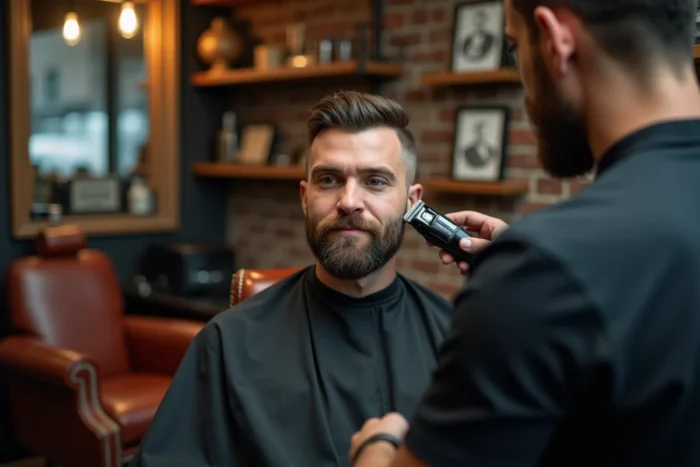
A less discussed angle: the professional perception of a shaved head has evolved in recent years. Analyses of the professional image of a shaved head suggest that it is now associated with traits of confidence and leadership in certain circles. However, the social stigma seems to have diminished compared to previous decades, although perception varies by industry.
Scalp care after shaving: common mistakes
The scalp exposed after shaving behaves like a sensitive skin area that requires a specific routine. Two mistakes frequently arise in user feedback on specialized forums.
The first concerns the frequency of shaving. Maintaining a perfectly smooth scalp requires shaving every two to three days depending on the rate of regrowth. Irregular maintenance creates an uneven texture that gives a neglected rather than intentional appearance.
The second mistake relates to hydration. Once shaved, the scalp is exposed to UV rays, cold, and wind without the natural protection of hair. A suitable, non-comedogenic moisturizer applied daily limits irritation and redness. In summer, sun protection on the scalp is essential.
- Shave with a clean, well-sharpened razor to avoid micro-cuts and ingrown hairs
- Apply a moisturizing treatment morning and evening in the first weeks to soothe irritation
- Protect the scalp from the sun with an appropriate SPF or headwear during prolonged exposure
- Use a gentle shampoo even without hair to cleanse the scalp and regulate sebum
A shaved head remains a reversible choice, and that is probably its best argument. Testing with clippers set to a few millimeters, observing the result under different lighting, adjusting beard and accessories: every step of preparation counts as much as the act of shaving itself.