The wedding theme is no longer just about choosing between “rustic” and “bohemian” from an inspiration catalog. Couples preparing their reception now build a complete artistic direction, where color palette, materials, music, and menu form a coherent whole. This more personal approach also raises concrete feasibility questions that inspiration articles rarely address.
Venue constraints and wedding theme: what blocks the process
Before validating a mood board, the first check focuses on the venue’s restrictions. Each municipality or building may impose its own conditions regarding music, candles, outdoor arches, confetti, or petals. A scenography designed around open flames or imposing floral structures may face a flat refusal on the day of the technical visit.
Private reception halls also enforce their own rules: prohibition on attaching items to walls, end-of-evening hours, limited access the day before for setup. The theme must be conceived after listing the venue’s constraints, not before. Reversing this order generates frustrations and additional costs when it comes to adapting or abandoning decorative elements that have already been ordered.
A couple dreaming of an outdoor wedding with a monumental arch and fairy lights must confirm electrical feasibility, ground stability, and backup weather conditions. Designing a plan B does not mean giving up the theme, but planning how it translates into a covered space if rain interrupts. Several providers now offer modular decorations designed to work both indoors and outdoors.
To explore the questions to ask at this stage, the site Et ils se Marièrent details the criteria that help arbitrate between aesthetic desire and logistical reality.
Personalized artistic direction: going beyond standardized themes
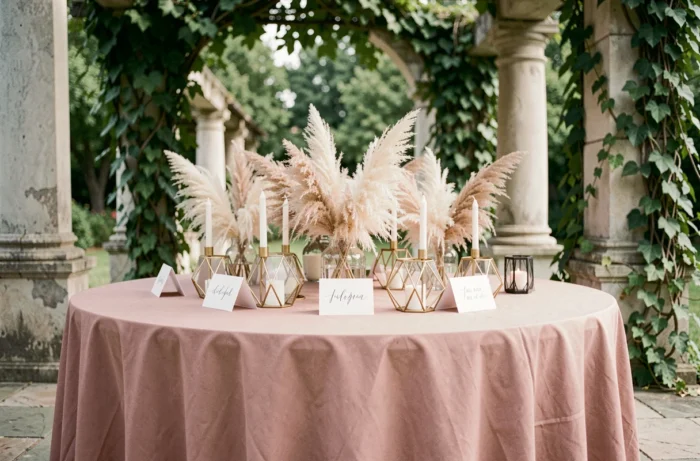
The market is evolving towards celebrations built around the couple’s story rather than ready-to-use decorative categories. A foundational journey, a shared passion, a place that marked the relationship become the starting point for a unique visual and sensory universe.
This approach requires translation work. Moving from a memory or emotion to a palette, materials, and sound ambiance involves defining precise codes. The risk, without this framing, is to produce an accumulation of decorative objects with no connection to each other.
Building coherence between stationery, menu, and decoration
Every element visible to guests must stem from the same guiding thread. If the theme is inspired by a trip to Greece, the stationery can incorporate ochre and blue hues, the menu can feature Mediterranean flavors, and the flowers can prioritize olive and lavender. Coherence does not come from overload but from the discreet repetition of a few codes.
Decorative sobriety is gaining ground, including in bohemian style. The recent trend replaces the accumulation of elements with a few strong artisanal pieces, raw materials, and airy spaces. Less decoration, better chosen, often produces a more striking effect than a room saturated with objects.
Decoration budget: the items that the theme affects
The choice of theme directly influences the budget, but not uniformly. Some items increase, while others decrease depending on the chosen direction.
- Fresh flowers represent one of the most variable items: a tropical theme or a fully floral wedding can cost several times more than a mineral or dried plant theme
- The rental of furniture and structures (arches, canopies, chandeliers) depends on what the venue already provides; a raw space requires everything, a furnished estate almost nothing
- Custom stationery (invitations, menus, seating plans, signage) is often an underestimated item when the theme requires a tailored graphic identity
- Lighting elements (garlands, neon signs, LED candles) vary depending on whether the venue has integrated ambient lighting
A sober and minimalist theme does not automatically mean a reduced budget. A few quality pieces can sometimes cost as much as abundant decoration in the mid-range. The trade-off is between quantity and level of finish.
Color palette and season: adapting the theme to real conditions
The season guides color and material choices more restrictively than one might think. Available flowers, natural light, and ambient temperature alter the perception of a decoration.
A winter wedding bathed in warm artificial light favors deep shades (burgundy, pine green, gold). A summer outdoor wedding better supports light colors and airy materials. Choosing a palette completely out of sync with the season requires compensating with artifices, which burdens logistics and the budget.
Testing colors in the venue’s actual conditions
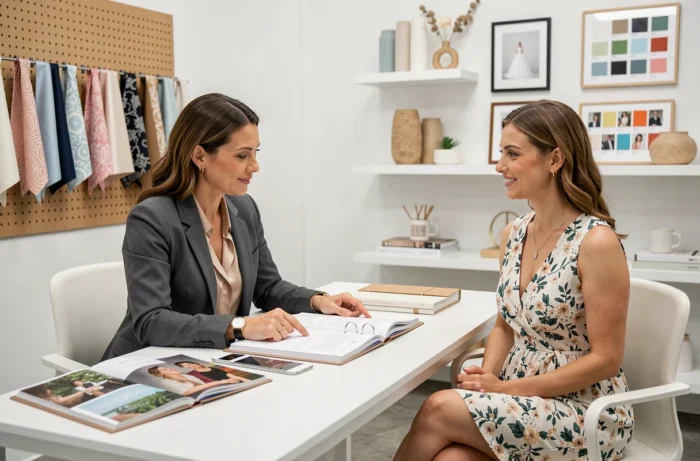
Fabric samples, table center prototypes, or lighting tests on-site allow verification that the result matches the intention. A color perceived as soft on a screen may appear dull under neon lighting, or too saturated in full sunlight.
Field feedback varies on this point: some couples feel that the venue visit in real conditions radically changed their initial palette, while others made no changes. The main variable remains the quality of the venue’s natural light.
The ideal theme does not exist in itself. It emerges from the confrontation between an aesthetic desire, the physical constraints of the venue, the available budget, and the chosen season. Couples who start with these concrete parameters before seeking inspiration on social media save time and avoid costly reversals during preparation.