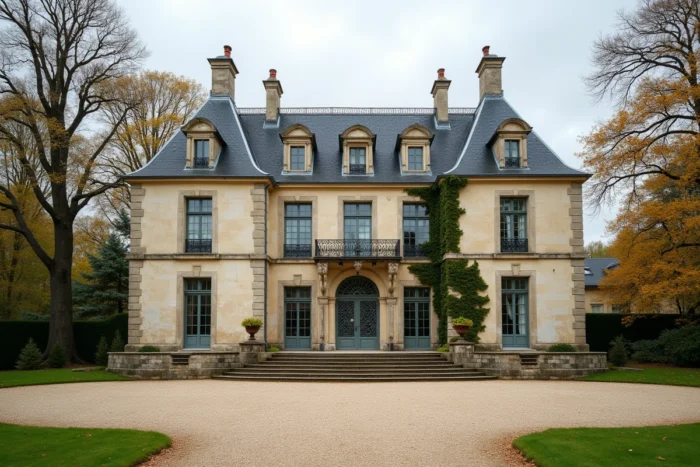
The Château de Groussay, located in Montfort-l’Amaury in the Yvelines, is currently owned by a SCI Château de Groussay backed by a French patron. Its precise identity remains little publicized, but the purchase of the estate in 2021 ended several years of judicial sequestration and opened a new chapter for this historic monument, which has been classified since 1993.
The judicial sequestration and the purchase of the Château de Groussay in 2021
Before the purchase, the château was under state sequestration following a court decision regarding the previous owner. During this period, the association Patrimoine Aventure carried out six years of volunteer work to preserve the site, maintaining a presence on-site to limit the degradation of the building and the park.
The acquisition by a French family, announced in February 2021, came with a commitment: to make the château a cultural landmark in the Yvelines after a two-year renovation phase. For those looking to understand who owns the Château de Groussay, the answer lies in this legal structure as a SCI, a common arrangement for heritage acquisitions of this scale.
The available data does not allow for detailing the amount of the transaction or the exact terms of the sale. The guarantees mentioned by local stakeholders focused on the cultural purpose of the site and the preservation of its classified historical monument status.
Charles de Beistegui and the transformation of the estate in the twentieth century
The history of the Château de Groussay cannot be understood without Charles de Beistegui. The central part of the building dates back to 1825, built for the Duchess of Charost as a country house. At that time, it was a large bourgeois residence, not a château in the architectural sense.
In 1938, Beistegui purchased the estate. The grandson of owners of Mexican silver mines, a cosmopolitan millionaire, he was looking for an unprotected property to express his historicist tastes without administrative constraints. He had previously lived in a Parisian apartment designed by Le Corbusier on the Champs-Élysées, an aesthetic universe at odds with what he would create at Groussay.
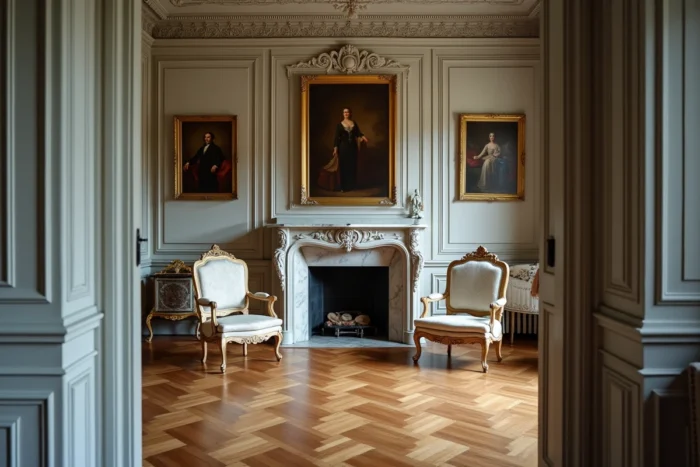
From 1939 until his death in 1970, in collaboration with architect and decorator Emilio Terry (nicknamed the “father of Louis XVII style”), Beistegui significantly enlarged and radically transformed the château. He added two wings, a theater with two hundred and fifty seats, and a ballroom known as the Dutch Room. The park, redesigned between 1950 and 1970, features structures inspired by various historical models.
The structures of the Groussay park
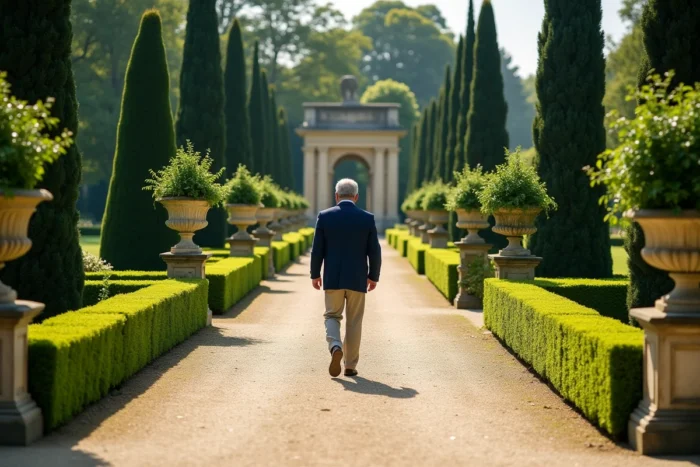
The park is one of the most distinctive elements of the estate. The structures, these ornamental constructions scattered throughout the gardens, are directly linked to the vision of Beistegui and Terry. Notably, there are:
- A pagoda, referencing the chinoiseries of the eighteenth century, which contrasts with the rest of the architectural vocabulary of the château
- A Palladian bridge, inspired by English models from the Age of Enlightenment, placed over a body of water
- A Tartar tent and an obelisk, elements borrowed from very distant decorative registers, yet united in a single landscaped pathway
This accumulation of styles is not random. Beistegui envisioned the park as an open-air theater, with each structure playing the role of an autonomous set piece in a global staging.
Groussay integrated into the cultural network of the Vallée de Chevreuse
The recent turning point concerns the inclusion of the château in a territorial cultural dynamic. The HELIUM Vallée de Chevreuse collective, which brings together artists and exhibition venues, presents Groussay as one of its partner sites. This network includes over a hundred artists, several dozen workshops, and about fifteen exhibition venues.
This positioning marks a break from the strictly private use of the château under Beistegui and the intermediate owners. The estate is becoming a space for contemporary art, not just a monument to visit.
A recent public market, referenced under activity codes related to the production and organization of cultural events, confirms this professional orientation. The château is no longer a mere frozen heritage object: it hosts technical services for performances and exhibitions, with a structured administrative framework.
A historical monument classification that frames the transformations
The classification of 1993 protects the entire estate (château, theater, structures, park). Any intervention on the building or gardens requires approval from state services. This constraint, which Beistegui had specifically sought to avoid by purchasing an unprotected property in 1938, now fully applies to the current owner.
However, this classification can also facilitate access to public funding for restoration, a significant lever given the scale of the estate and the diversity of structures to maintain (structures, theater, ballroom, landscaped park).
Château de Groussay: the lingering gray areas
Several questions remain open. The exact identity of the patron behind the SCI has not been the subject of detailed public communications. The progress of the works announced in 2021 for a duration of two years lacks accessible reports.
The cultural programming seems active, but feedback from the field varies on the degree of public access. The château remains primarily a private residence classified as a historical monument, which structurally limits the possibilities for regular visits.
What seems certain: the estate has emerged from sequestration, it is in the hands of an actor engaged in a cultural approach, and its integration into the HELIUM network anchors Groussay in the artistic landscape of the Yvelines. The rest will depend on the owner’s ability to sustain a project that combines heavy heritage restoration with contemporary programming, two logics that are rarely simple to reconcile.