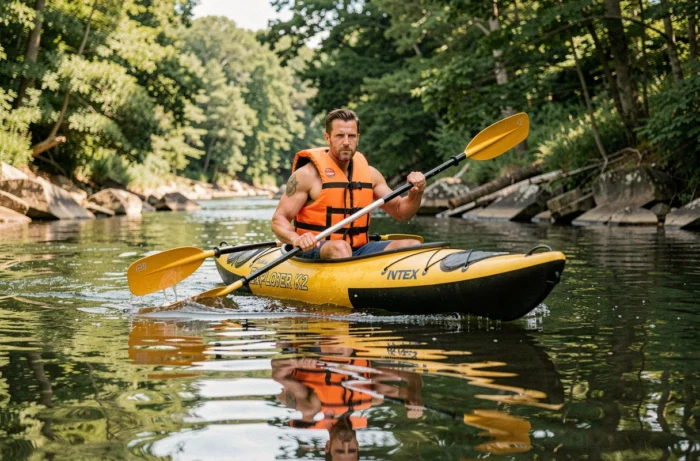
The Intex Explorer K2 is 312 cm long and 91 cm wide, with a maximum load capacity of 180 kg. These dimensions place it in the compact inflatable kayak category, designed for two adults on calm water. The question is what these specifications mean in practice: how stable is it, how comfortable is it for the rear paddler, and, above all, what regulatory restrictions apply to an inflatable kayak of this size in France?
Inflatable kayaks under 3.50 m: what French maritime regulations say
Most reviews of the K2 focus on comfort or value for money. None address the regulatory question, even though it determines how the product can actually be used.
In France, a human-powered kayak under 3.50 m is classified as a beach craft. This classification limits navigation to within 300 m of shelter, during daylight hours only. At 312 cm, the K2 falls into this category.
For vessels measuring 3.50 m or more that meet buoyancy and watertightness requirements, the limit increases to 2 nautical miles from shelter. They must also carry buoyancy equipment rated at least 50 N per person and a device that allows occupants to stay in contact with the vessel after capsizing. At nearly 40 cm below this threshold, the K2 does not qualify for this category.
For anyone considering the Intex Explorer K2 kayak for coastal use, the restriction is clear: stay within the 300 m limit, wear personal flotation equipment, and carry an individual light if the waters are classified as “exposed”.
Requirements differ on inland waters: personal flotation equipment must be worn, but the distance restriction does not apply in the same way. This is where the K2 is best suited, on calm lakes and rivers where its classification is no longer a drawback.

Intex Explorer K2 specifications compared with regulatory thresholds
| Criterion | Intex Explorer K2 | Regulatory threshold (beach craft) |
|---|---|---|
| Length | 312 cm | Under 3.50 m |
| Width | 91 cm | Not specified |
| Maximum load | 180 kg | Not specified |
| Maximum distance from shelter (at sea) | 300 m | 300 m |
| Night navigation permitted | No | No |
| Flotation equipment required | Yes (not supplied as standard with a 50 N rating) | Yes |
The table highlights a point that is rarely mentioned: the flotation vest included in the Intex pack is a comfort accessory, not 50 N-certified equipment. For a trip at sea, even within the 300 m limit, you need to buy compliant life jackets separately.
K2 stability and comfort on calm water
On a lake or slow-moving river, the 91 cm width provides a stable seat. The K2 does not rock with every small movement, which reassures beginners. The two side air chambers and inflatable floor add to this sense of solidity.
The 0.75 mm-thick vinyl can withstand light rubbing against rocks just below the surface or submerged branches. It is not a high-performance material, but it holds up to the conditions found on a lake or a Class I river.
Seat comfort and paddling position
The inflatable seats are removable and adjustable. The rear paddler has a reasonable amount of space, provided they are no taller than 1.85 m. Taller paddlers will find their knees pressing against the back of the front seat, limiting their paddling range.
Comfort remains acceptable for trips lasting one to two hours. Beyond that, the lack of firm lumbar support becomes noticeable. The supplied aluminum paddles do the job without excelling: they are lightweight but flexible, making them suitable for a leisurely pace.
Inflation and setup with Boston valves
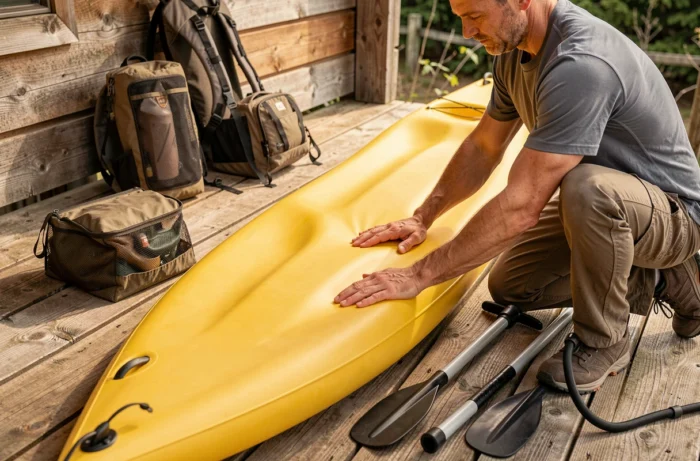
The Boston valves allow quick inflation with the supplied hand pump. Allow about ten minutes to inflate the three chambers and install the seats. Deflation is faster, and the folded kayak fits into a carry bag about the size of a cabin bag.
- Three independent air chambers: if one deflates, the other two maintain buoyancy
- Removable directional fin clipped beneath the hull, improving straight-line tracking
- Front storage area with elastic net for a small dry bag or a bottle
Practical limitations of the K2 in real-world conditions
The K2 is not designed for Class II rivers or higher. Even a moderate current makes it difficult to keep on course, especially with an inexperienced paddler at the rear. The removable fin helps on flat water, but cannot make up for the lack of a rigid keel in a cross-current.
Wind is another limiting factor. With a large exposed surface area (91 cm wide, with high sides), the K2 catches crosswinds. On a windy lake, you have to paddle constantly to stay on course, which quickly becomes tiring.
- Crosswinds above 15–20 km/h: difficult paddling and constant drift
- Currents stronger than Class I: the K2 becomes unstable and difficult to maneuver
- Trips lasting more than two hours: significant back discomfort without an extra cushion
- Combined occupant weight close to 180 kg: the waterline drops and stability decreases noticeably
The K2 excels in specific conditions: calm water, light winds, and short trips. Outside these conditions, its structural limitations quickly become apparent. For regular use or more demanding waters, a drop-stitch model or an entry-level rigid kayak offers significantly better performance.
The K2’s price (often under 200 euros, and sometimes below 130 euros at certain clearance retailers at the start of the season) reflects its positioning. It is a beginner’s kayak for occasional leisure use, not a touring craft. At this price, the value for money is reasonable, as long as you do not expect it to do what it was not designed for.