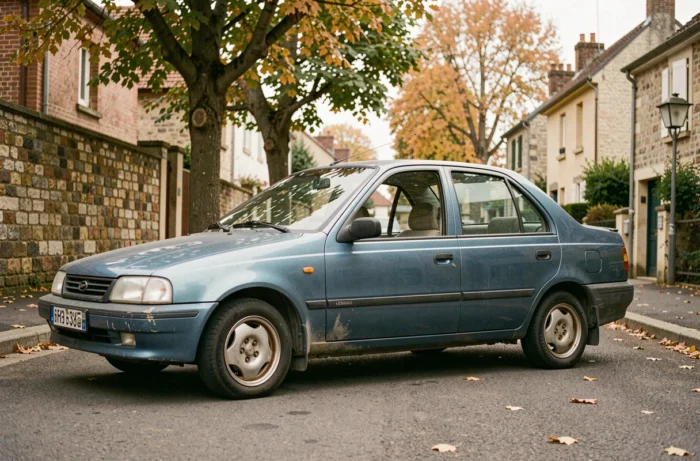
Daewoo Motors did not simply disappear from the French market: the brand was methodically absorbed by General Motors through a rebadging strategy that erased its identity in less than a decade. Understanding this trajectory requires revisiting the technical choices, the models distributed in France, and the industrial mechanisms that led to this dissolution.
Chevrolet Rebadging: The Strategy to Erase the Daewoo Brand
The acquisition of Daewoo Motors’ assets by General Motors in 2002 did not lead to an immediate halt in production. GM created GM Daewoo Auto & Technology, retaining the Korean assembly lines and existing platforms. The transition to Chevrolet occurred model by model.
The Matiz, Lacetti, and Nubira continued to roll off the same production lines, with the same chassis and engines, but under a Chevrolet badge. The product remained identical; only the brand changed. In France, this shift took place between 2005 and 2011, a period during which both logos sometimes coexisted in dealerships.
This rebadging method was not trivial: it allowed GM to capitalize on the Chevrolet network while gradually liquidating the Daewoo image, deemed too associated with the 1999 bankruptcy. Spare parts, manufacturer references, and technical sheets still bore traces of the Korean origin, but the final consumer no longer had visual access to them. The complete catalog of these affiliations remains available at daewoo-automobile.fr, which lists the correspondences between Daewoo and Chevrolet references.
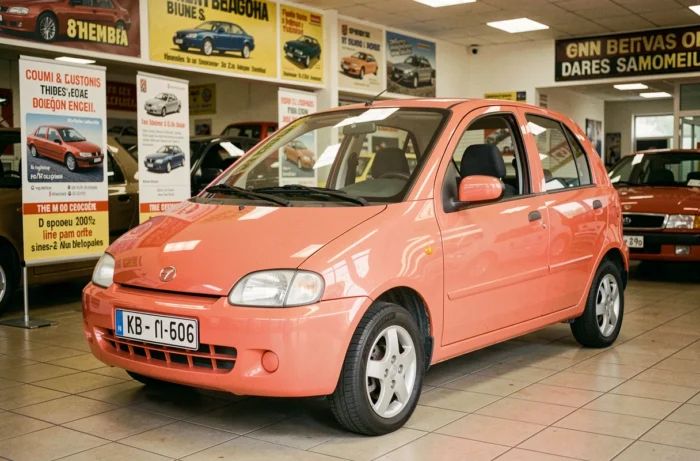
Daewoo Range Sold in France: Models and Price Positioning
The range distributed in the French market covered all segments, from city cars to road sedans. This broad positioning for a low-cost manufacturer is explained by the structure of the Korean market, where large sedans dominate sales.
- Matiz: compact city car derived from an Italdesign Giugiaro design, which became the best-selling model of the brand in Europe thanks to a significantly lower price than competitors in segment A
- Lanos: compact sedan offered in three and five-door versions, positioned against the Renault Clio and Peugeot 206 with superior standard equipment for a reduced price
- Nubira: family sedan and station wagon, a direct competitor of the Opel Astra and Ford Focus, available with modest displacement gasoline engines
- Leganza: mid-size sedan designed by Giugiaro, targeting segment D with an ambition to move upmarket that never convinced the French market
- Evanda: large sedan replacing the Leganza, the last model distributed under the Daewoo badge in France before the Chevrolet transition
The common denominator of this range remained a catalog price significantly lower than European and Japanese competition. The trade-off was on residual value: the depreciation of used Daewoo vehicles was among the most severe in the market, a phenomenon amplified after the announcement of the group’s bankruptcy.
Espero and Nexia: The Pioneer Models in the European Market
Before the Matiz, Daewoo tested the European market with the Espero (derived from the Opel Ascona platform) and the Nexia (rebadged from the Opel Kadett E). These two models, distributed from the mid-1990s, shared a structural characteristic: their mechanical bases were aging GM platforms, sold at low cost to the Korean manufacturer.
We observe that this dependence on GM platforms defined the technical DNA of Daewoo throughout its European existence. The brand never developed a proprietary platform for its models sold in France.
Direct Daewoo Distribution: A Cutting-Edge Business Model
In 1995, Daewoo experimented in the UK with a proprietary distribution network, bypassing traditional dealerships. The Korean manufacturer wanted to directly capture the end customer, control prices, and eliminate intermediary margins.
This model foreshadowed the direct sales strategies that several Chinese manufacturers are now attempting in Europe. The difference: Daewoo did not have the current digital tools to manage customer relationships remotely. The proprietary network operated with physical showrooms, without an e-commerce component.
In France, this approach was not deployed with the same radicality. Daewoo had to navigate the French regulatory framework for automobile distribution and open traditional subsidiaries. The commercial results remained modest compared to the UK market, where the brand had managed to establish itself more quickly thanks to its direct model.
1999 Bankruptcy and Consequences for the French Car Fleet
The Asian crisis of the late 1990s hastened the fall of the Daewoo group. The chaebol, heavily indebted after aggressive international expansion, was declared bankrupt in 1999. For French owners of Daewoo vehicles, the consequences were tangible.
The supply of spare parts became uncertain during the transitional period between the bankruptcy and the acquisition by GM. Independent workshops found themselves searching for compatible parts from Opel or Isuzu, exploiting the platform relationships. The compatibility of GM parts remained the main asset for keeping these vehicles operational.
The resale value collapsed almost immediately after the bankruptcy announcement. Used Daewoo vehicles became among the cheapest on the French market, a situation that persisted long after the acquisition by GM. This brutal depreciation illustrates a mechanism we see today with certain Chinese brands whose sustainability in the European market remains uncertain.
Daewoo Car Insurance: A Special Case After the Brand’s Disappearance
Insurers gradually reclassified Daewoo models under their Chevrolet equivalents in their pricing databases. For owners of vehicles still on the road, the manufacturer code remains a point of vigilance when subscribing to a car insurance contract: some rating systems no longer recognize the Daewoo name and require the corresponding Chevrolet reference.
The story of Daewoo in France ultimately boils down to two technical observations. The brand demonstrated that a manufacturer could offer a complete range at reduced prices by recycling amortized GM platforms. It also proved that without a distinct technical identity, an automotive brand disappears as soon as its industrial partner decides to regain control.